FOR FUNDERS AND FOUNDATIONS
Your evaluation told you what happened. It did not tell you why it keeps happening.
Most evaluation holds a programme still and measures it. Activities delivered. Outputs counted. Targets compared. The report arrives at the end of a grant cycle, describes what was done, and rarely explains why the same problems return in the next one.
Nuvora Impact maps the dynamics around a programme before deciding what to measure inside it. The result is evidence that shows where to intervene, not just what to report.
WHAT WE HEAR FROM FUNDERS
"We fund good programmes. The evaluation confirms they worked. Then the same problem comes back. What are we missing?"
Usually what is missing is not more data. It is a map of the system the programme sits inside. A literacy programme can raise reading scores and still fail to change educational outcomes if the constraint is not pedagogy but household economics pulling children out of school. A standard evaluation would report the reading scores as a success. A systems-informed evaluation would show why the success did not hold.
Evaluation has good traditions for this. Developmental evaluation, realist evaluation and contribution analysis all ask what worked, for whom, and under what conditions. What is still rare in practice is a funder-side evaluation that begins with an explicit causal map of the system, then designs the methodology to test the links in that map.
That is where Nuvora Impact starts.
Three ways we work with funders
01
Single-programme evaluation
You need to know whether a programme you fund is working and what to do about it. We map what's actually driving the outcomes, then design the evaluation to test that, rather than only checking whether activities happened.
You get a report written for the room it will be read in. Your grantee gets the map and a debrief, so the evaluation leaves them with something instead of taking something.
Scope: 10 to 12 weeks. One programme
02
Portfolio learning synthesis
Not "did this programme work" but "what is this portfolio telling us". We read across the evaluations, reports and monitoring data you already hold, looking for the barrier that keeps appearing and the conditions your strongest grants share.
You get a learning framework your team uses to decide where the next grant has most leverage. No new fieldwork and if something surfaces that needs it, we say so and scope it separately.
Scope: 6 to 8 weeks . Designed for portfolios of 5 or more grantees.
03
Evidence strategy and MEL design
Most evidence problems are set at the start, when nobody has decided what the grant is meant to prove. We work with the programme team in the first quarter to map what the programme depends on, then build the theory of change, indicators and data collection from that.
It costs less than fixing it at endline and it produces evidence that explains what happened rather than only counting what was done.
Scope: 4 to 6 weeks per grantee. Often bundled as a condition of grant.
Depending on whether you're asking about a grant you've made, a portfolio you hold, or a grant you haven't made yet.
THE APPROACH
What a causal map shows before the methodology is written.
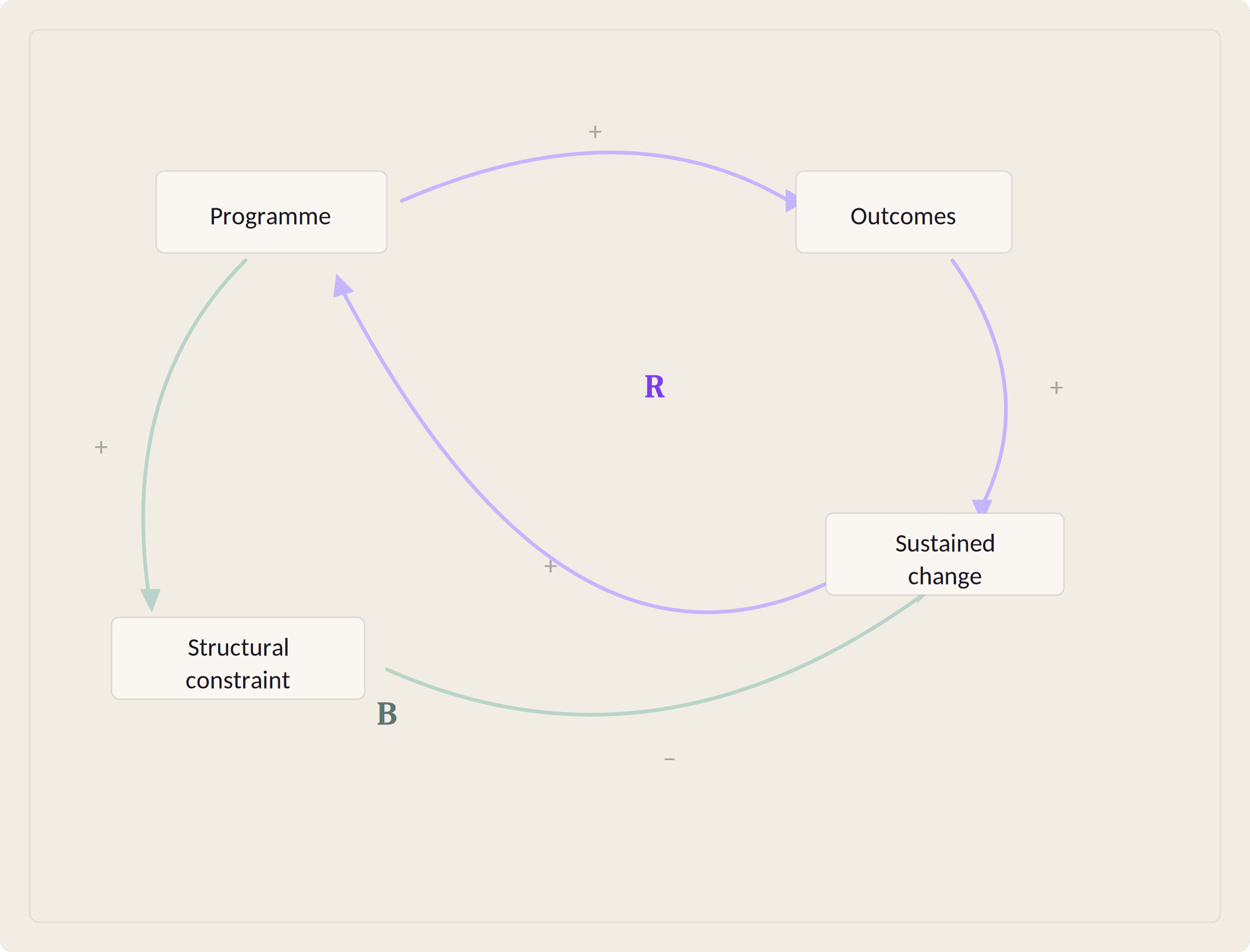
Every programme sits inside a system of reinforcing and balancing dynamics. Reinforcing loops amplify what the programme is trying to do. Balancing loops constrain it. When an evaluation measures activities and outputs without mapping those dynamics, it can confirm a programme worked while missing the structural forces that will erode the outcome within a year.
A causal loop diagram makes those forces visible before the methodology is designed. It shows where the real leverage points are, which is often not where the programme's own logic model points.
The map determines what we measure. What we measure is shaped by the decision you need to make, not the data that is easiest to collect.
Simplified: a reinforcing loop (R) drives outcomes towards sustained change. A balancing loop (B) pulls against it. Standard evaluation measures the outcomes. Systems-informed evaluation maps both loops and measures the links between them.
THE DIFFERENCE
What changes when your evaluator has sat in your chair.
The brief gets sharper.
Most evaluators accept the brief as given. A former grant-maker knows which questions the brief is not asking, and raises them before the methodology is locked.
The findings are decision-shaped.
An evaluation can be methodologically sound and operationally useless. We structure every finding around a decision you can make: renew, restructure, scale, or stop. The causal map makes it clear which decision addresses the root cause and which addresses a symptom.
The evaluation sees the system, not just the programme.
Standard evaluation holds one programme and measures it. Systems-informed evaluation maps what reinforces it, what constrains it and what the programme cannot change alone. That is the difference between a report that says "this worked" and one that explains why it worked here but not there.
The grantee relationship is protected.
Evaluation creates tension between funder and grantee. A practitioner who has managed both sides of that relationship knows how to produce honest evidence without damaging the trust the programme depends on.
The report is not the product.
The product is the conversation that the report makes possible. We design deliverables for the room they will be read in: a board meeting, a grant committee, a grantee debrief. Format follows audience.
START HERE
Let's chat
We begin every engagement by mapping the dynamics your current evidence is not capturing. Tell us the programme or portfolio, the timeline and what the evidence needs to do.
Start a Conversation →
No obligation. No pitch deck. Just the right question.
Where evidence meets purpose
© 2026 Nuvora Impact Private Limited. All rights reserved.